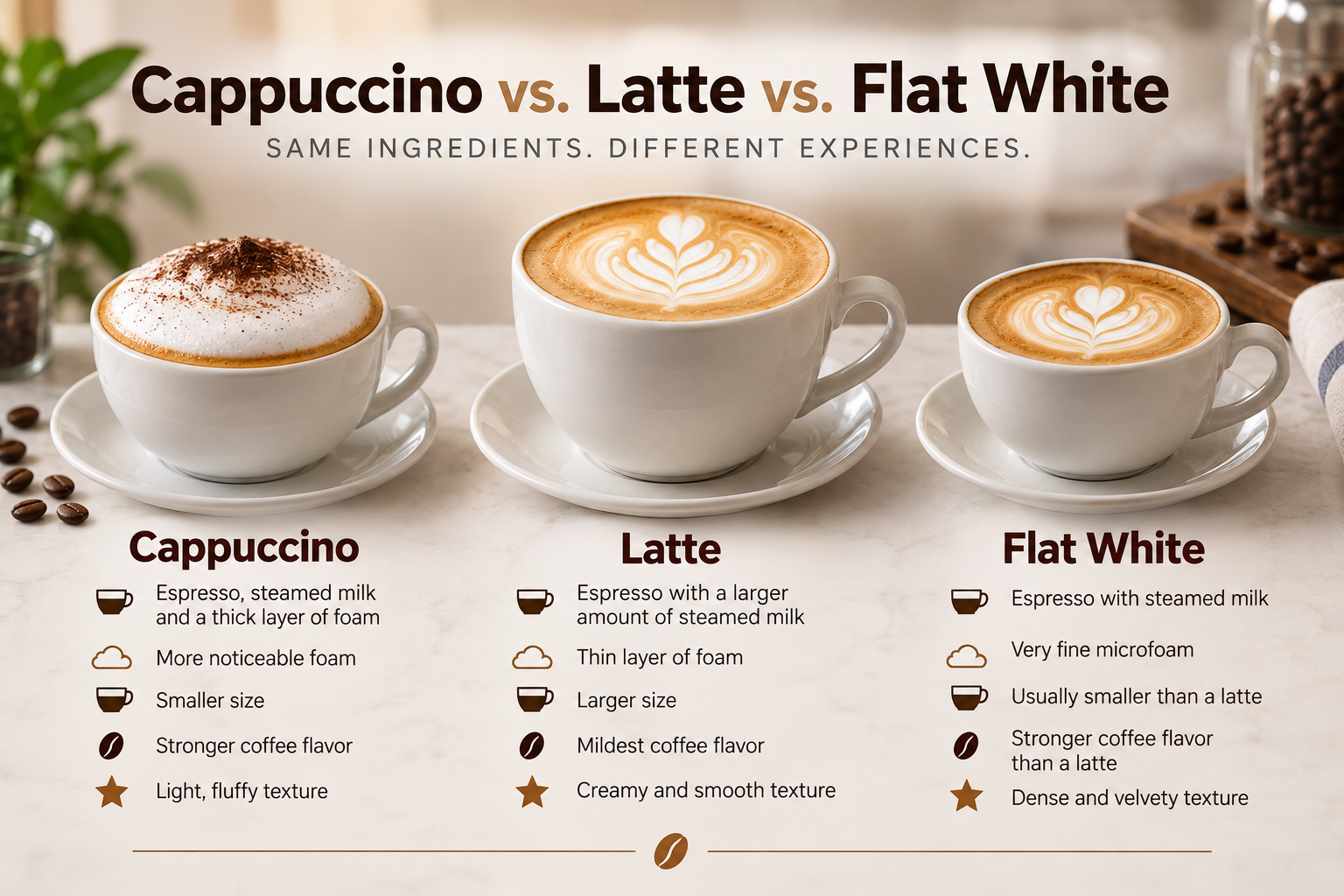
If you are new to specialty coffee, ordering a coffee can sometimes feel like learning a new language. You walk into a café and see cappuccino, latte, flat white, macchiato, cortado, americano and more. They may all contain espresso and milk, but they can taste surprisingly different.
Among the most popular choices are the cappuccino, latte, and flat white. All three are espresso-based milk coffees, yet the amount of milk, texture of the foam, serving size, and balance between coffee and milk give each one its own personality.
So, which should you order?
The good news is that you don’t need to be a coffee expert to understand the difference. In this beginner-friendly guide, we’ll break down cappuccino vs. latte vs. flat white in simple terms, explain what each drink tastes like, and give you practical examples to help you choose your next cup.
First, What Do They All Have in Common?
Before looking at the differences, let’s start with what these three drinks share.
A cappuccino, latte, and flat white all begin with espresso. Espresso is concentrated coffee made by forcing hot water through finely ground coffee under pressure.
Baristas then combine the espresso with steamed milk.
The important difference isn’t simply whether a drink contains milk. It’s how much milk is used and how that milk is prepared.
Think of it this way:
- Espresso = the coffee foundation
- Steamed milk = adds sweetness, creaminess, and body
- Milk foam = adds texture and a lighter mouthfeel
Change the proportions and texture, and you get a completely different coffee experience.
What Is a Cappuccino?
A cappuccino is probably the most recognizable of the three.
Traditionally, it consists of roughly equal parts:
- Espresso
- Steamed milk
- Milk foam
The exact proportions can vary between cafés and countries, especially in modern specialty coffee, but the defining characteristic is its thick, airy, creamy foam.
A cappuccino is usually served in a relatively small cup compared with a latte.
What does a cappuccino taste like?
Because there isn’t an enormous amount of milk, the espresso remains noticeable. At the same time, the steamed milk softens the coffee’s bitterness and adds natural sweetness.
The foam gives the drink a light, fluffy texture.
Imagine taking a sip and getting:
Rich espresso → sweet steamed milk → soft, airy foam.
That’s the cappuccino experience.
A practical example
Imagine you order a cappuccino at a specialty café.
You might receive a small cup containing a shot or two of espresso, topped with silky steamed milk and a generous layer of microfoam. The drink feels creamy but relatively light compared with a large latte.
If you enjoy the taste of coffee but still want something smooth and milky, a cappuccino can be an excellent starting point.
What Is a Latte?
A caffè latte, usually shortened to simply “latte,” contains significantly more steamed milk than a cappuccino.
A typical latte has:
- Espresso
- A larger amount of steamed milk
- A thin layer of microfoam on top
The result is a larger, milkier drink.
What does a latte taste like?
The larger amount of milk makes a latte milder and creamier than a cappuccino.
Milk contains natural sugars, and steaming it brings out its sweetness. As a result, the espresso becomes softer and less intense.
For someone who finds straight espresso too strong, a latte can be an easy introduction to coffee.
A practical example
Suppose you normally drink tea or enjoy creamy drinks.
You might find a latte more approachable because the coffee flavor is blended with plenty of warm, silky milk.
This is also why lattes are popular with flavored syrups.
Vanilla latte? Caramel latte? Hazelnut latte?
These work particularly well because the relatively mild coffee-and-milk base allows additional flavors to stand out.
What Is a Flat White?
The flat white is often associated with Australia and New Zealand and has become a staple in specialty coffee shops around the world.
It sits somewhere between the cappuccino and latte in terms of milk quantity, but its defining feature is its fine, velvety microfoam.
Unlike a traditional cappuccino, a flat white generally doesn’t have a thick, fluffy cap of foam.
Instead, the steamed milk is integrated closely with the espresso.
What does a flat white taste like?
A flat white tends to have a stronger coffee presence than a latte, while being smoother and less foam-heavy than a cappuccino.
The texture is particularly important.
Good microfoam feels almost like silk or wet paint. Instead of separating into obvious layers of coffee, liquid milk, and foam, the espresso and milk come together into a smooth, unified drink.
For specialty coffee beginners who want to taste more of the espresso while still enjoying creamy milk, the flat white is worth trying.
Cappuccino vs. Latte vs. Flat White at a Glance
Here’s the simplest comparison:
| Feature | Cappuccino | Latte | Flat White |
|---|---|---|---|
| Coffee base | Espresso | Espresso | Espresso |
| Milk amount | Moderate | More | Moderate |
| Foam | More noticeable | Thin layer | Very fine microfoam |
| Texture | Light and foamy | Creamy and silky | Dense and velvety |
| Coffee flavor | Noticeable | Mildest | Strong and balanced |
| Typical size | Smaller | Larger | Usually smaller than a latte |
| Best for | Foam lovers | Mild, creamy coffee | Stronger coffee + silky milk |
Keep in mind that there is no single universal recipe for these drinks. Cup sizes, espresso doses, milk quantities, and preparation techniques vary from one café to another.
The Biggest Difference: Milk-to-Coffee Ratio
If you remember only one thing from this article, remember this:
The amount of milk changes how strongly you taste the espresso.
Generally speaking:
Cappuccino
Less milk + more foam = stronger coffee character with a fluffy texture
Latte
More milk + less foam = milder, creamier coffee
Flat white
Less milk than a latte + very fine microfoam = strong espresso character with a smooth texture
This doesn’t mean that a cappuccino always has more caffeine than a latte or flat white.
If all three drinks are made with the same amount of espresso, their caffeine content can be very similar.
The difference is mainly in flavor, texture, and concentration, not necessarily caffeine.
Why Does Milk Foam Matter So Much?
For beginners, the word “foam” can make cappuccino and flat white sound almost identical. But there’s an important difference.
Baristas don’t simply heat milk and pour bubbles into coffee.
In specialty coffee, milk is usually steamed to create microfoam—tiny, integrated bubbles that produce a smooth and creamy texture.
A cappuccino traditionally emphasizes a thicker layer of foam.
A latte usually has a thinner layer.
A flat white focuses on fine, velvety microfoam that blends closely with the espresso.
This is why two drinks containing the same ingredients can feel completely different when you drink them.
It’s similar to eating the same ingredients prepared in different ways. The ingredients matter, but technique matters too.
Which One Has the Strongest Coffee Flavor?
This is one of the most common questions beginners ask.
The answer depends on the recipe and café, but as a general rule:
Flat white → Cappuccino → Latte
from stronger coffee perception to milder coffee perception.
However, don’t confuse “stronger taste” with “more caffeine.”
A latte made with two espresso shots can contain more caffeine than a small flat white made with one shot.
The perceived strength comes largely from the ratio of espresso to milk.
If you want to taste the characteristics of the coffee beans—such as chocolate, caramel, nuts, berries, or citrus—a flat white or cappuccino may make more sense than a very milky latte.
Which One Is Creamiest?
That depends on what you mean by “creamy.”
A latte generally feels milkier and smoother because it contains more steamed milk.
A flat white can feel particularly rich and velvety because of its finely textured microfoam.
A cappuccino is creamy too, but its foam creates a lighter, airier sensation.
So you could think of them like this:
Latte: creamy and milky
Flat white: silky and velvety
Cappuccino: creamy and foamy
Which Coffee Should a Beginner Try?
There’s no wrong answer. Your choice should depend on what you already enjoy.
Choose a cappuccino if…
You enjoy:
- A noticeable coffee flavor
- A foamy texture
- A smaller drink
- A traditional café experience
- A balance between espresso and milk
Example: You want something more exciting than a milky coffee but don’t want to drink straight espresso.
Try a cappuccino.
Choose a latte if…
You enjoy:
- Creamy drinks
- Mild coffee flavor
- More milk
- Larger drinks
- Adding flavors such as vanilla or caramel
Example: You are new to coffee and find espresso too bitter or intense.
Start with a latte.
Choose a flat white if…
You enjoy:
- A stronger coffee flavor
- Smooth textures
- Less foam
- Balanced espresso and milk
- Specialty coffee
Example: You already enjoy coffee and want the espresso to remain the star without drinking it black.
Try a flat white.
What About Latte Art?
You may have noticed beautiful hearts, tulips, and rosettas floating on top of specialty coffee drinks.
That’s latte art.
Despite the name, latte art isn’t limited to lattes. Cappuccinos and flat whites can also feature beautiful designs when the milk has been properly steamed and poured.
The image of a heart on your coffee isn’t what makes it a latte.
Instead, the art comes from the texture and pouring technique of the steamed milk.
In fact, good microfoam is essential for creating clean latte art.
Does the Type of Coffee Bean Change the Difference?
Absolutely.
The same cappuccino recipe can taste completely different depending on the coffee beans used.
For example, a coffee with chocolate and nutty notes may produce a cappuccino that tastes rich and comforting.
A light-roasted coffee with fruity or floral characteristics may create a much brighter and more complex flat white.
Specialty coffee shops often give you information about:
- Origin
- Roast level
- Processing method
- Flavor notes
- Espresso blend
Don’t worry if these terms seem confusing at first.
Start by paying attention to what you actually taste.
Do you notice chocolate?
Nuts?
Caramel?
Fruit?
Something acidic or citrusy?
The more coffees you try, the easier it becomes to recognize these differences.
A Simple Experiment for Coffee Beginners
Want to understand the difference rather than simply memorize it?
Try this.
Order a cappuccino, latte, and flat white from the same specialty café, preferably using the same espresso.
Taste them one after another.
Start with the cappuccino.
Notice the foam and how strongly you taste the espresso.
Then try the latte.
Ask yourself:
Does the extra milk make the coffee taste softer?
Finally, taste the flat white.
Pay attention to its texture and how closely the milk and espresso blend together.
This simple experiment can teach you more than reading dozens of coffee definitions.
Common Misconceptions About These Coffees
“A cappuccino is just a latte with more foam.”
Not quite.
While the drinks share the same basic ingredients, their traditional proportions and milk textures differ. The preparation style contributes significantly to the final experience.
“A flat white is just a small latte.”
That’s an oversimplification.
Although they can look similar, a flat white generally emphasizes a stronger espresso presence and very fine, integrated microfoam.
“A latte has less caffeine.”
Not necessarily.
Caffeine depends primarily on the amount and type of espresso used. A large latte can contain the same or more caffeine than a smaller cappuccino.
“Bigger means stronger.”
Usually, the opposite can be true in terms of coffee flavor.
A larger drink often contains more milk, which can make the espresso taste less concentrated.
The Bottom Line
Cappuccino, latte, and flat white may all start with the same basic ingredients—espresso and steamed milk—but the proportions and milk texture create three distinct experiences.
A cappuccino is the foamy, balanced choice. It’s ideal when you want espresso flavor combined with a generous, airy layer of milk foam.
A latte is the milkiest and generally the mildest of the three. It’s a great choice if you prefer a smooth, creamy coffee or are just beginning your coffee journey.
A flat white is all about balance and texture. It gives you a stronger espresso presence than a latte while using silky microfoam rather than a thick layer of foam.
The best choice ultimately comes down to what you enjoy.
If you’re new to specialty coffee, don’t worry about ordering the “right” drink. Try different coffees, pay attention to flavor and texture, and notice what you like.
Because specialty coffee isn’t about memorizing rules.
It’s about discovering the cup you love.
Leave a Reply